Community strategies: publish your own, follow what others build
Soar's strategy marketplace lets traders share the strategies they build — and lets you follow them with an honest, realized track record in view.

Every trader eventually builds a way of reading the market that feels like their own — a set of themes, a basket of names, a rule for when a setup counts. On Soar, that thinking doesn't have to stay locked in your head. The community strategy marketplace lets you publish the strategy you built, and it lets you follow one another trader shared, with an honest track record in plain view before you decide anything.
The idea is simple: strategies are more useful when they're visible, comparable, and accountable. So the marketplace treats every shared strategy the same way — as a public thesis you can inspect, not a promise you're asked to trust on faith.
What a community strategy actually is
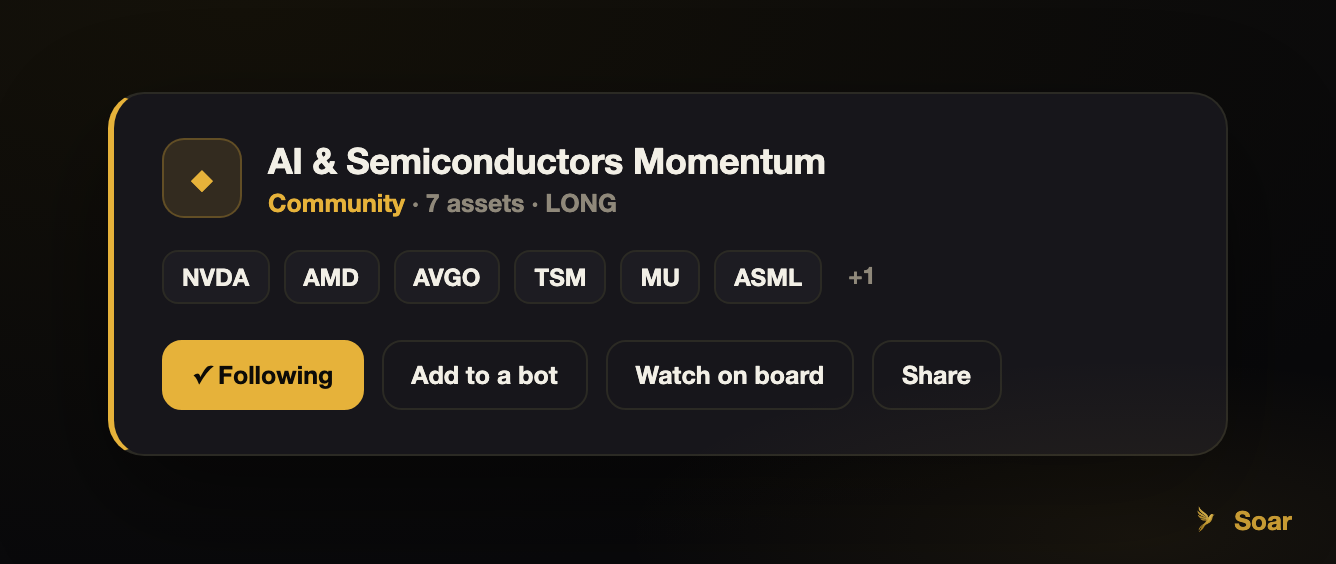
A strategy on Soar is a defined lens — a way of choosing what to watch and grade. When you build one, you're describing the universe of assets and the themes you care about. Publishing it makes that lens available to other traders. Following it brings that lens into your own experience, either onto your dashboard board or assigned to a bot you run.
That gives the marketplace two natural roles, and most active traders play both:
Publishers share a strategy they built. Their signals are their own analysis — a public thesis, not a recommendation endorsed by Soar.
Followers browse what others have published, review the track record, and choose which strategies to add to their board or a bot.
Both — the same trader often publishes one strategy while following a few others to see how different lenses read the same market.
The track record you see is realized, not imagined
This is the part that matters most. When you open a strategy's page in the marketplace, the track record on display is realized — built from what actually happened on the record, not a backtest tuned to look good in hindsight. Backtests are easy to make flattering; a live, on-the-record history is not.
So before you follow anything, you're looking at the same honest ledger everyone else sees. You can read any strategy's own page from the strategy marketplace and judge it on its record rather than on a headline. That's the whole point of putting it in the open.
Following a strategy should be a decision made with the record in front of you — not a leap of faith taken on a pitch.
Following is a choice — and you stay in control
Adding a community strategy to your world is always deliberate. Nothing joins your board automatically, and nothing is traded on your behalf without your say-so. When you follow a strategy, you decide where it goes:
Add it to your dashboard board to watch how it reads the market alongside your own strategies — a view-only way to learn a lens before you commit to it.
Assign it to a bot you run, so its signals become part of what that bot considers.
Remove it whenever you want — following is reversible, and you can trim your lineup at any time.
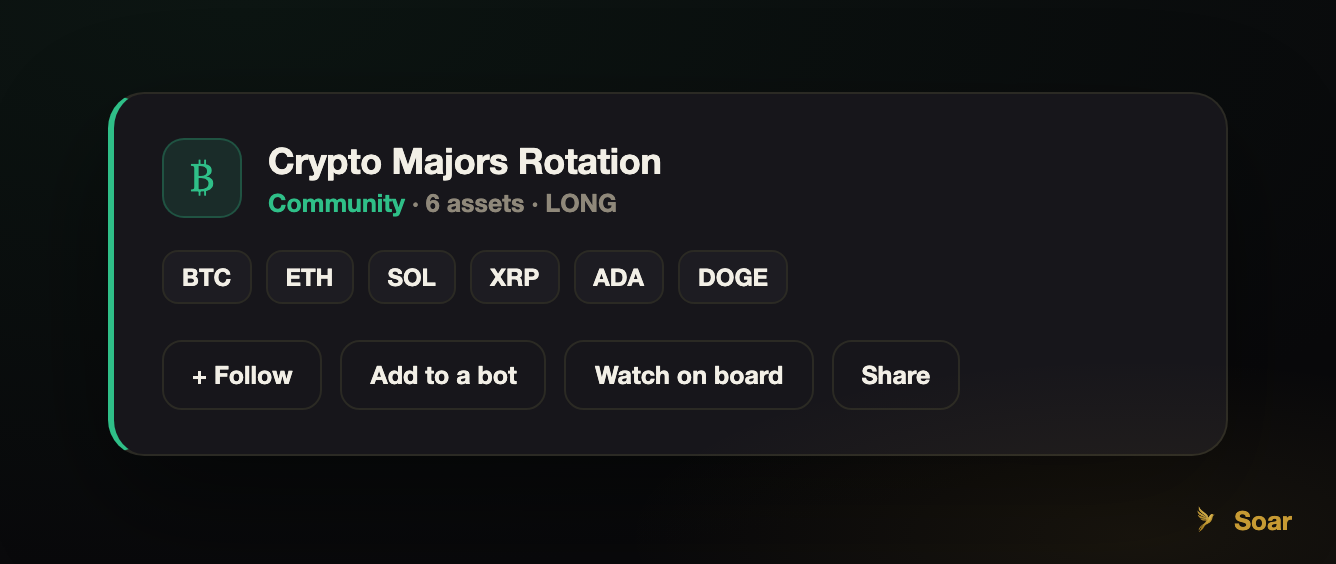
The rule underneath all of it is firm: a bot only trades the strategies you assign to it. Watching a strategy on your board is not the same as trading it. You choose what each bot acts on, and that choice is always yours to change.
Publishing what you built
If you've built a strategy on Soar that you're proud of, publishing shares it with the community — and it starts accumulating the same realized, on-the-record history that every other source carries. There's no shortcut around that ledger; a published strategy earns its track record by being live, the same as any other.
Publishing is also an act of transparency in both directions. Followers see that a publisher's signals are the publisher's own analysis — a viewpoint offered, not a verdict from Soar. That framing keeps the marketplace honest: it's a place to share thinking and compare records, not a leaderboard of promises.
How your keys and funds stay safe
Following a strategy and running a bot are two separate things, and the security model around trading is the same no matter whose strategy a bot follows. If you self-host, your broker API keys live only on your own infrastructure and never touch Soar's servers. If you use Soar-managed hosting, keys are stored encrypted and scoped to trade-only, with your consent.
In every case, access is trade-only — Soar can place trades a bot is configured to make, but Soar can never withdraw or move your funds. Community strategies change what a bot might consider; they never change that boundary.
Getting started
Open Soar and head to the strategy marketplace to see what the community has published. Browse a few, read their realized track records, and add one to your board to watch it work before you commit further. When you're ready to share your own lens, publish it and let the record speak. If you want the fundamentals first, the help center walks through strategies, boards, and bots, and the daily brief is a good way to keep a pulse on the market while you decide. More product deep-dives live on the blog.
Informational and educational content only. Not investment advice. Trading involves risk, including loss of capital.