
Meet Soar Copilot: build a strategy by describing it in plain English
Say what you want to trade and how you want it managed. Copilot turns it into a strategy you can put a bot on.


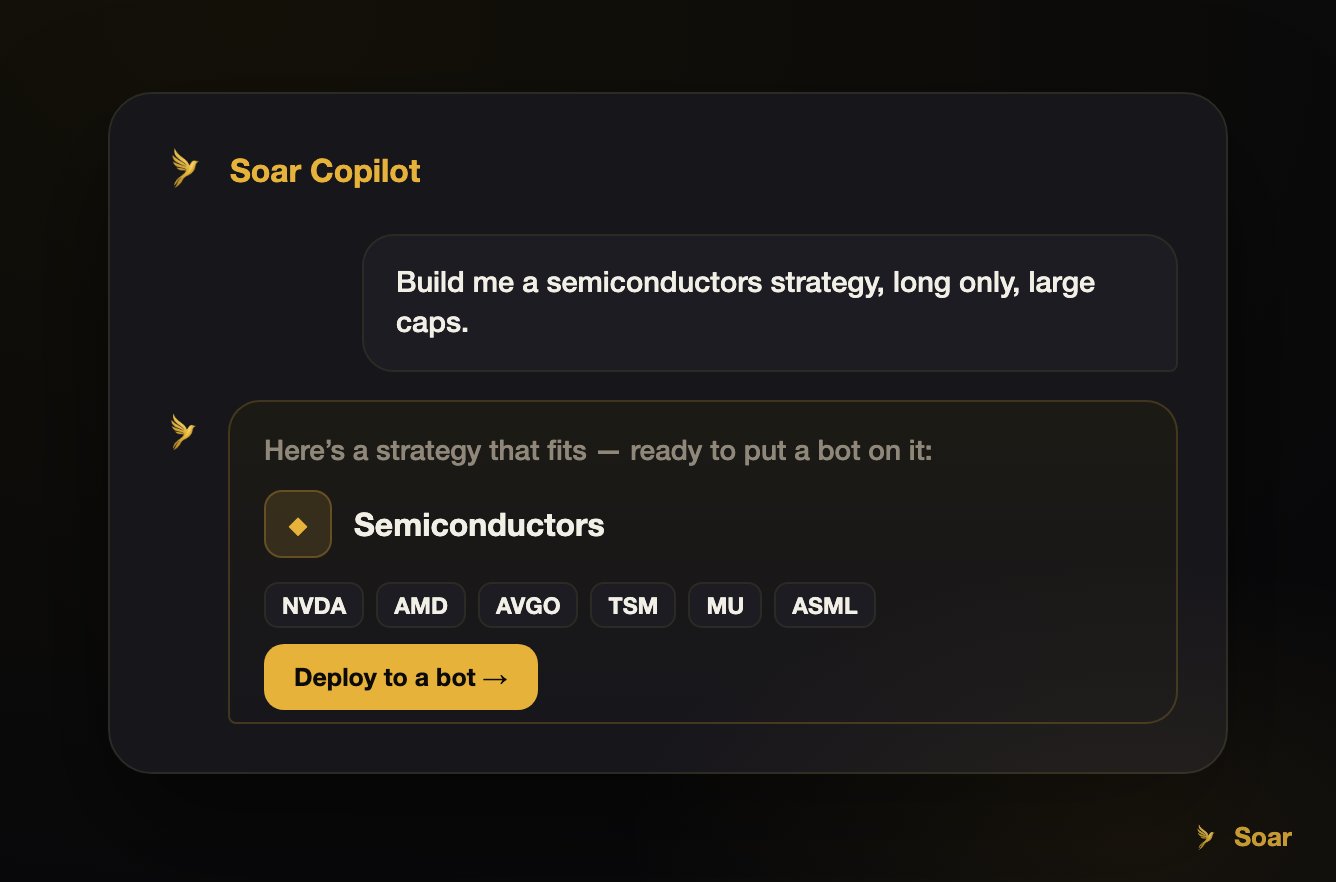
Most trading tools ask you to speak their language first — pick a screener, wire up conditions, memorize where every setting lives. Soar Copilot flips that around. You describe what you want in plain English, and it does the assembling. Say something like "I want to follow semiconductor names with a conservative risk setup," and Copilot turns that intent into a real strategy you can review and put a bot on.
It's the conversational front door to Soar. No jargon to learn, no forms to fill out — just a conversation that ends with something you can actually deploy.
What Copilot actually is
Copilot is Soar's in-app conversational assistant. It has one job: help you go from an idea to a working setup without getting lost. In practice, it does three things well.
Builds strategies from a description. You tell it the theme, the direction, and how you want risk handled. It composes a strategy from real, named sources — never made-up tickers or invented signals.
Applies a strategy to a bot. Once you're happy with what it assembled, Copilot can walk you through putting an autonomous bot on it, right inside the conversation.
Answers product questions. Not sure what a setting does or how something works? Ask. Copilot is a product guide, so you're never stuck reading docs mid-flow — though the full help center is always there too.
One thing worth being clear about: Copilot is a product assistant, not a financial adviser. It helps you build and understand, not tell you what will happen.
How a strategy comes together
When you describe an idea, Copilot resolves it into the concrete pieces a strategy needs — the assets in scope, the direction, and how the setup should be managed. It draws from Soar's real strategy sources rather than conjuring anything up, so what you get back maps to something you can actually inspect.
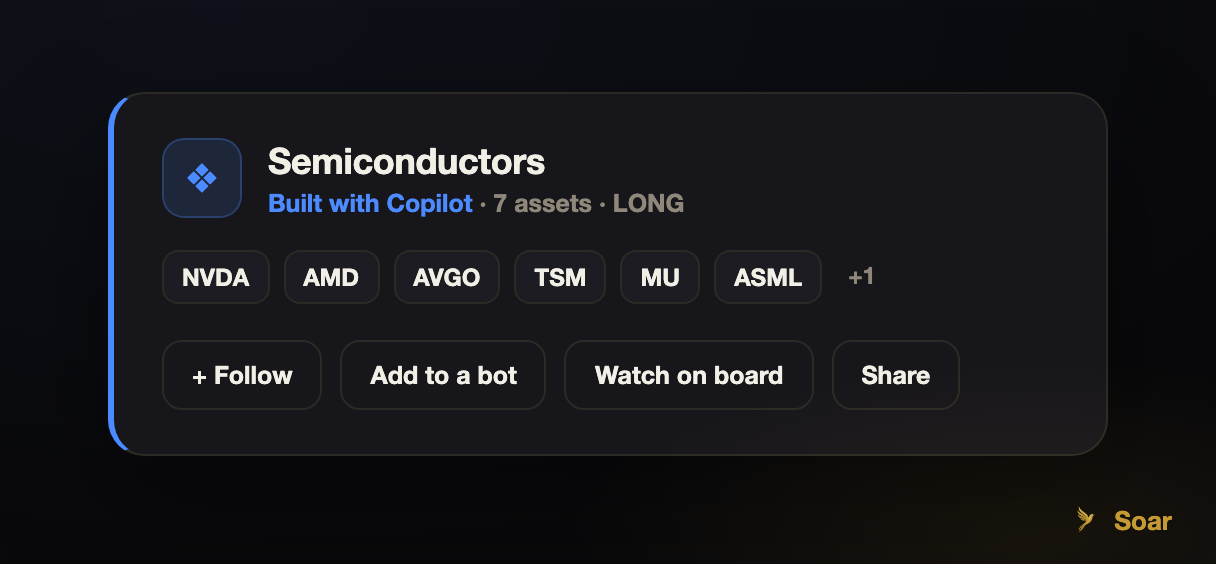
You can browse those sources yourself on the strategy pages. Each one is a public, named thesis you can read before you commit to it. Copilot's role is to take your words and point them at the right building blocks, then hand you back an assembled strategy to review.
You describe intent. Copilot resolves it into a real strategy — assets, direction, and risk — that you can see and change before anything goes live.
Because it's a conversation, refining is easy. Don't like the risk posture? Say so. Want to narrow the universe or shift the direction? Just describe the change. You're steering the whole time — Copilot handles the translation from plain English into a real configuration.
Deploying happens right in the flow
The part that usually breaks the momentum in other tools — connecting a broker — happens inside the Copilot conversation. When you're ready to put a bot on your strategy, Copilot walks you through connecting your broker step by step, without kicking you out to a separate wizard or a wall of setup screens.
And it never fakes it. Copilot will not pretend a broker is connected or invent a connection that doesn't exist. If something needs to happen on your end, it tells you plainly. That honesty matters most where trust matters most — the boundary between describing a strategy and putting real money behind it.
Your keys, your control
However you connect, access is always trade-only. Soar can never withdraw or move your funds — full stop. There are two ways to run a bot, and the custody model is transparent in both:
Self-hosting — your broker API keys live only on your own infrastructure and never touch Soar's servers.
Soar-managed hosting — your keys are stored encrypted and scoped to trade-only, with your explicit consent.
Either way, the boundary is the same: a bot can place and manage trades according to the strategy you built, and nothing more. Copilot explains this as part of the flow, so you know exactly what you're agreeing to before you deploy.
Where to start
The best way to understand Copilot is to talk to it. Open the app, describe a strategy in your own words — a theme you're watching, a direction, a risk style — and see what it assembles. From there you can refine it, read the underlying strategy sources, and, when you're ready, connect a broker without ever leaving the conversation.
If you'd rather warm up first, the daily brief is a good place to get a feel for how Soar reads the market, and the blog covers more of how the platform works. But honestly? The fastest path is just to start describing what you want.
Informational and educational content only. Not investment advice. Trading involves risk, including loss of capital.