How Soar grades a strategy — and why your bot only trades what survives
Pick a strategy, Soar’s engine grades every setup, and a bot trades only the ones that clear the bar.

Most trading products hand you a signal and hope for the best. Soar works the other way around: you pick a strategy, Soar’s engine grades every setup it produces against live technicals and risk rules, and a bot only ever trades the ones that clear the bar.
Pick a strategy
A strategy on Soar is a lens — a set of assets, directions, and timeframes you care about. It can be a curated basket (Semiconductors, Crypto Majors), a public-record tracker (Congress, Pelosi), or one you build yourself in the Studio with per-asset long/short calls.
Picking a strategy does not place a single trade. It tells Soar what to watch.
Soar grades every setup
Behind every strategy is the Soar engine. For each asset in the lens, it reads the live tape, scores the setup, and assigns a conviction. Weak setups are dropped before they ever reach you. What survives is a graded, risk-checked trade card — entry, targets, stop, and the thesis behind it.
Every card carries real levels, not vibes — entry, two targets, and a stop.
Conviction and risk/reward are computed, then gated. Setups that fail the bar are cut.
The track record you see is realized — wins are banked targets, losses are clean stops.
A bot trades only what clears the bar
Deploy a bot to a strategy and it trades autonomously, 24/7, on your own broker — your keys never touch Soar. The bot only opens new positions from the graded cards, sizes them to your risk profile, and never touches the positions you already hold.
Your board is what you watch. Your bots trade their own strategies. Adding a strategy to a bot is the step that turns watching into trading.
See it for yourself
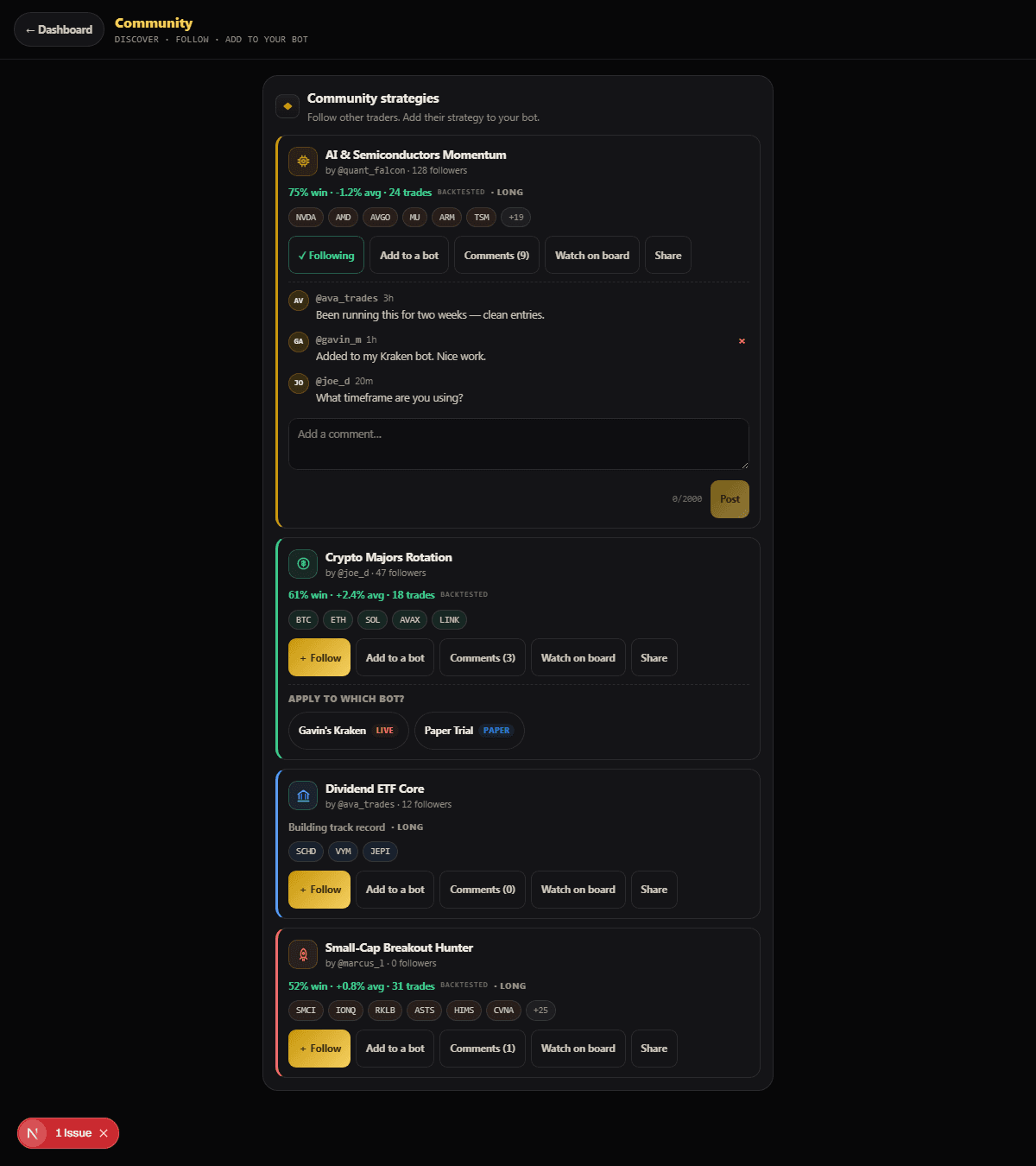
Browse the community to follow strategies other traders have published — each shows a real, backtested track record before you ever add it. When one fits, add it to a paper bot and watch it work.