The Situational Awareness strategy: trading the Aschenbrenner AGI thesis
Leopold Aschenbrenner argued the race to AGI will pull a trillion-dollar compute-and-power buildout forward. Soar's newest strategy is a lens on the companies that build it.

In 2024, a former AI-lab researcher named Leopold Aschenbrenner published a long, widely-read essay titled Situational Awareness: The Decade Ahead. Its argument was blunt: progress toward advanced AI may be arriving faster than most people assume, and if it does, it will demand a staggering physical buildout — chips, data centers, and the electricity to run them. Soar's newest strategy, Situational Awareness (Aschenbrenner), is a lens built around that public thesis. It doesn't predict AGI. It watches the companies that would have to be built up if the thesis were even partly right.
What Aschenbrenner actually argued
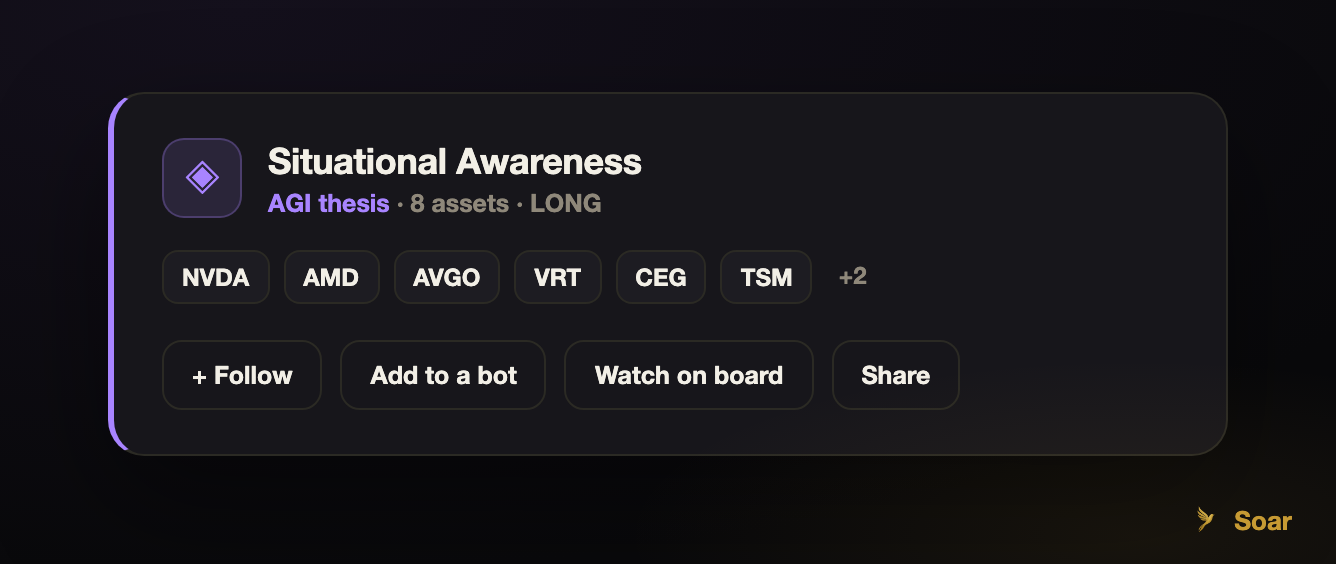
The essay is a piece of public writing, and we're treating it as exactly that — a thesis worth reading, not a prophecy to bet the house on. The core claim is that AI capability has been scaling with compute, and that continuing to push capability forward means an enormous, sustained expansion of the infrastructure underneath it. Aschenbrenner frames this as a physical, industrial problem as much as a software one.
Distilled to its market-relevant edges, the thesis points at a few concrete buckets:
Compute — the accelerators and networking gear that training and inference run on.
Data centers — the buildings, cooling, and land where that compute lives.
Power — the electricity generation, grid capacity, and energy supply chains needed to feed it all.
The suppliers behind all three — the less obvious names that provide equipment, materials, and services into the buildout.
You don't have to fully believe the timeline to notice that these are real, investable categories. That gap — between a bold public thesis and the mundane companies that would build it — is the space Soar's strategy sits in.
A thesis about the future is a story. A basket of the companies that would build that future is a lens you can actually watch.
How Soar turns a thesis into a lens
Soar's Situational Awareness (Aschenbrenner) strategy — filed under the AGI FUND category — expresses the idea as a basket of AI-infrastructure-exposed equities. Rather than trying to time a single stock or call the arrival of AGI, it groups together the kinds of names the essay implies: the compute, data-center, and power exposure that a large-scale AI buildout would lean on.
The Soar engine then does what it does across every strategy on the platform: it reads each name in the basket on its own merits — technicals, market context, and the setup in front of it — and surfaces what it sees. The thesis defines what to watch. The engine handles how to read it. A strategy on Soar is a repeatable lens, not a one-time hot take.
You can browse this and every other strategy from the app, and follow the market context around them in the daily brief.
Why a themed lens is useful
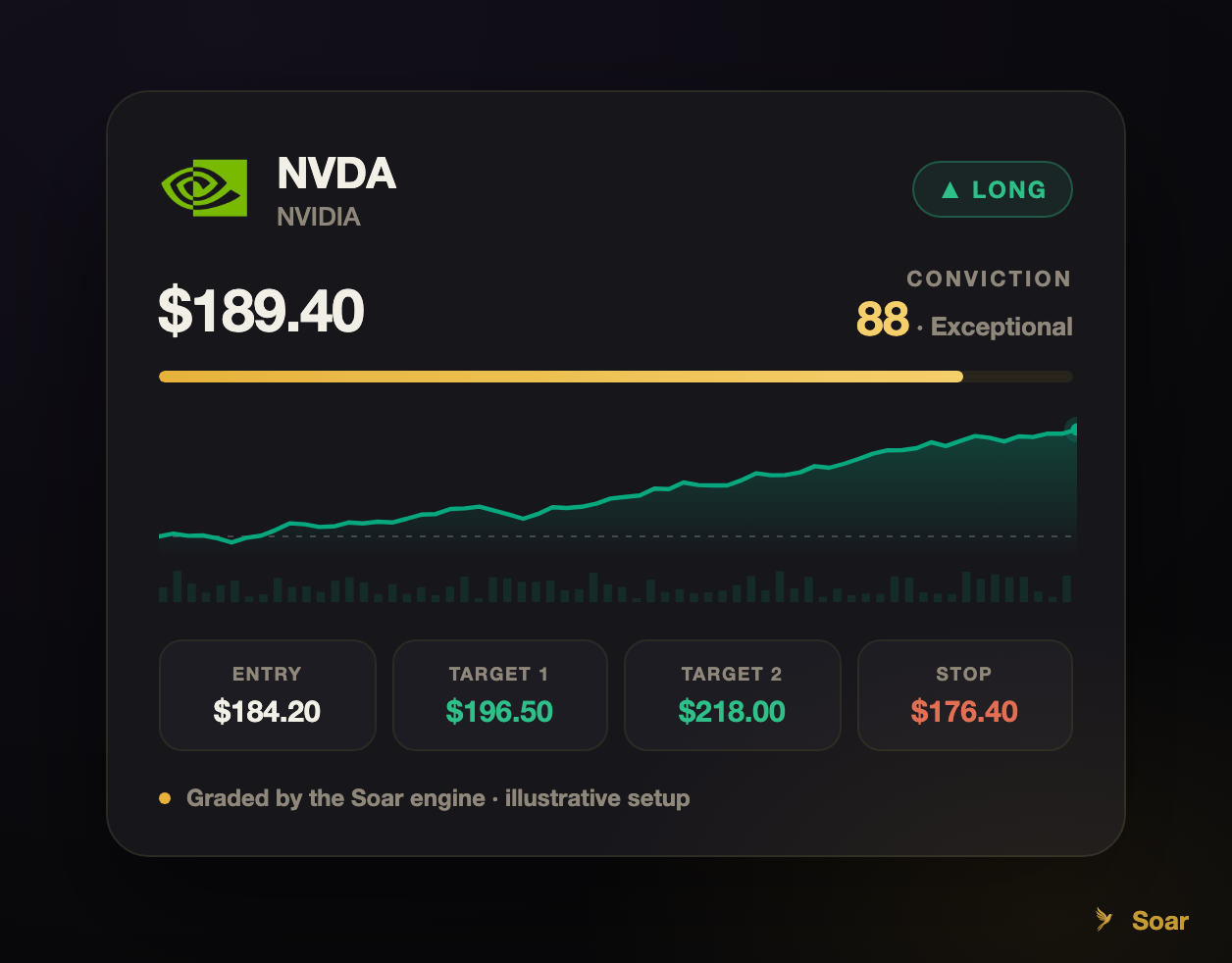
Themed strategies exist because attention is scarce and the market is enormous. If the AI-infrastructure story interests you, the Situational Awareness lens gives you a single, coherent surface to follow it — instead of manually stitching together a watchlist across chipmakers, data-center operators, and utilities and hoping you didn't miss the interesting name.
A few things worth being clear about:
It is commentary on a public thesis, not a claim that the thesis is correct.
It is a lens for what to watch, not a promise about what anything will do.
It is one of many strategies on Soar — you choose which lenses matter to you, and you can follow, ignore, or combine them.
Soar is not affiliated with Leopold Aschenbrenner. The strategy references his public essay the way any market commentary references a public source — by name, plainly, with credit to the original writing. It's a thesis we found worth building a lens around, nothing more.
How it fits with the rest of Soar
Like every strategy on the platform, Situational Awareness can be followed as pure research or, if you choose, routed to an automated bot that trades it for you within limits you set. When you connect a broker, access is always trade-only — Soar can never withdraw or move your funds. If you self-host, your broker API keys live only on your own infrastructure and never touch Soar's servers; if you use Soar-managed hosting, keys are stored encrypted, scoped to trade-only, and only with your explicit consent.
If you're new to how any of this works, the help center walks through strategies, brokers, and the difference between watching a lens and letting a bot act on it. And if you'd rather just read for a while, more strategy write-ups live on the blog.
The Situational Awareness strategy won't tell you whether Aschenbrenner is right about the decade ahead. What it does is give you a clean, consistent way to keep an eye on the companies his argument points to — and to decide for yourself what, if anything, that's worth.
Informational and educational content only. Not investment advice. Trading involves risk, including loss of capital.