Managed or self-hosted: how you run your Soar bot — and why it's safe either way
Run the bot on your own infrastructure where your keys never leave, or let Soar host it with encrypted, trade-only access. Either way, Soar can never move your money.

The single most important question before you hand a trading engine any kind of access is a simple one: who can touch my money, and how? With Soar, the answer never changes no matter how you set things up. You choose where your bot runs, and in both configurations the access is trade-only. Soar can place and manage trades on your behalf — and it can never withdraw or move your funds.
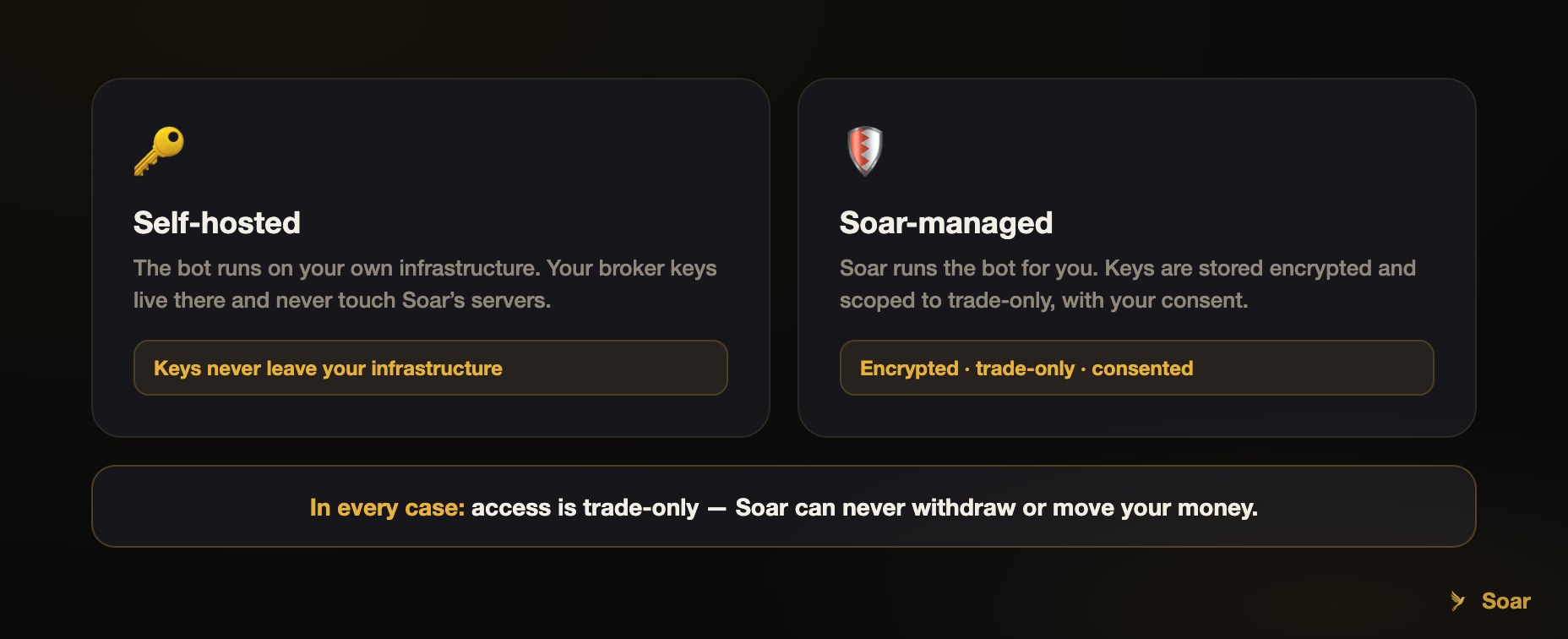
There are two ways to run a Soar bot. You can self-host it, where your broker API keys live only on your own infrastructure and never touch Soar's servers. Or you can let Soar manage it, where your keys are stored encrypted and scoped to trade-only, with your explicit consent. This piece walks through both, plainly, so you can pick the one that fits how you like to operate.
The invariant that never changes: trade-only
Start with the part that's identical across both models, because it's the part that matters most. When you connect a broker to Soar, the access is scoped to trading actions only. That means the bot can open, adjust, and close positions according to the strategy you've chosen — but the permission to withdraw funds, transfer balances, or move money off your account is simply never granted.
Whichever way you run it, Soar can trade for you — and can never withdraw or move your money. That boundary is the same in both models.
This is a deliberate design choice, not a setting you have to remember to toggle. The distinction between "can trade" and "can withdraw" is the line that separates a trading tool from a custodial one, and Soar stays firmly on the trading side of it.
Self-hosted: your keys never leave your infrastructure
If you prefer maximum control, self-hosting is for you. In this model, your broker API keys live only on infrastructure you own and control. They are never received by, stored on, or routed through Soar's servers. The bot runs on your side and talks to your broker directly.
The practical upshot is that Soar simply never holds your keys. There's nothing on our end to leak, because the sensitive material stays with you the whole time. What Soar provides is the engine's read on the market and the strategy logic; the connection to your broker is yours.
Your keys, your infrastructure. Broker credentials stay entirely on your side and never touch Soar's servers.
Trade-only, still. Even self-hosted, the access you grant your broker is scoped to placing and managing trades — not withdrawals.
Full control. You decide where and how the bot runs, and you can disconnect at any time.
No custody, anywhere. Nobody — not Soar, not the bot — holds the ability to move your funds.
Self-hosting suits people who want the tightest possible custody boundary and are comfortable running their own setup. It's the model where the phrase "not your keys, not your coins" flips entirely in your favor — they are your keys, and they stay that way.
Soar-managed: encrypted, consented, and still trade-only
Not everyone wants to run their own infrastructure, and that's completely reasonable. The Soar-managed model exists for exactly this. Here, you give explicit consent for Soar to host the bot, and your keys are stored encrypted and scoped to trade-only. You get the convenience of a hands-off setup without giving up the boundary that matters.
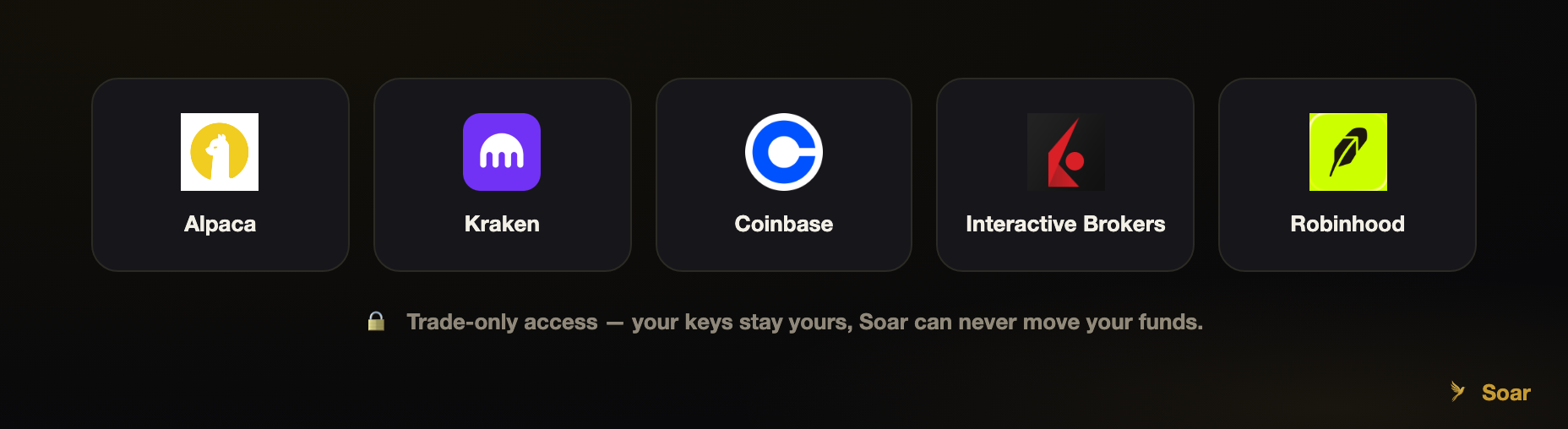
Two things do the heavy lifting in this model. First, encryption: your credentials are stored in encrypted form, not sitting around in the open. Second, scope: they're limited to trading actions, so even in a managed setup the ability to withdraw or move funds is never part of the picture. And none of it happens without your say-so — the managed path is opt-in and consent-based by design.
If self-hosting is the model of maximum control, Soar-managed is the model of maximum convenience — with the same non-negotiable at its core.
Which one should you choose?
There's no wrong answer, because the safety floor is the same either way. Choose based on how you like to work:
Pick self-hosted if you want your keys to physically never leave your own infrastructure and you're happy running the setup yourself.
Pick Soar-managed if you'd rather Soar handle the hosting, and you're comfortable with encrypted, consented, trade-only storage.
Either way, the access is trade-only and Soar can never withdraw or move your money.
You can explore the strategies a bot can run over on the strategy pages, read the details on setup in the help center, or just open the app and see how it fits your workflow. If you like to stay close to the market first, the daily brief is a good place to start.
The bottom line
The choice between self-hosted and Soar-managed is a choice about where the bot lives, not how much trust you're extending. Self-hosted keeps your keys entirely on your own infrastructure. Soar-managed keeps them encrypted and consented on Soar's side. In both, the engine does one job — trade the strategy you picked — and the one thing it can never do is touch your money. For more on how Soar thinks about signals, strategies, and safety, keep reading on the blog.
Informational and educational content only. Not investment advice. Trading involves risk, including loss of capital.