Rare earths & critical minerals: the supply-chain strategy
Magnets, batteries, and chips all depend on a short list of minerals with concentrated supply. Soar's Rare Earths strategy is a lens on that chain.

The motor spinning inside an electric vehicle, the battery under its floor, and the chip coordinating both of them all trace back to the same short list of raw inputs. Rare earths, lithium, and a handful of other critical minerals are the quiet foundation of the electrified, digitized economy — and unlike the products they enable, they come from a small number of places. That concentration is the whole story. It's why these materials show up in trade negotiations, export controls, and national-security memos, and it's the reason Soar runs a strategy that keeps a lens on the companies that dig them up and refine them.
The Rare Earths & Critical Minerals strategy is an industry-basket lens on the miners and processors behind this supply chain. It's commentary on a public thesis — a way to watch a theme, not a promise about it. Here's what the thesis is and why the theme behaves the way it does.
Why "critical" is a technical word, not a marketing one
A mineral gets labeled critical when two things are true at once: modern technology genuinely needs it, and its supply is fragile enough that a disruption would be hard to absorb quickly. That combination is what separates critical minerals from ordinary commodities. Iron ore is essential too, but it's mined widely and traded deeply. The critical basket is different — demand is rising fast while supply sits behind a narrow gate.
The materials in this conversation tend to sort into a few buckets:
Rare earth elements — a group of metals prized for the permanent magnets inside EV motors, wind turbines, and precision electronics.
Battery minerals — lithium and its cousins that store the energy in phones, laptops, grid storage, and vehicles.
Semiconductor and specialty inputs — the trace materials that chip fabrication and advanced electronics depend on.
Processing and refining capacity — the often-overlooked middle step where raw ore becomes usable material, which is frequently more concentrated than the mining itself.
That last point matters more than it looks. You can pull ore out of the ground in many countries, but turning it into magnet-grade metal or battery-grade chemical happens in far fewer places. The bottleneck often lives downstream, not at the mine mouth.
Concentrated supply is a feature of the theme, not a footnote
This is what makes the sector geopolitics-sensitive in a way that most industries aren't. When supply is spread across dozens of producers, a single policy shift is noise. When a large share of processing sits in one region, an export rule, a tariff, or a stockpiling decision can ripple through the whole chain — and through the companies attached to it.
Ordinary commodities react to demand. Critical minerals react to demand and to who controls the gate between the ground and the finished product.
That's why headlines about trade policy, resource nationalism, and "friend-shoring" of supply chains tend to move this group together. The miners and processors are exposed to the same forces at the same time. A basket lens exists precisely because these names share a story — watching them as a cohort surfaces the theme in a way that staring at any single ticker doesn't.
What the Soar strategy actually does
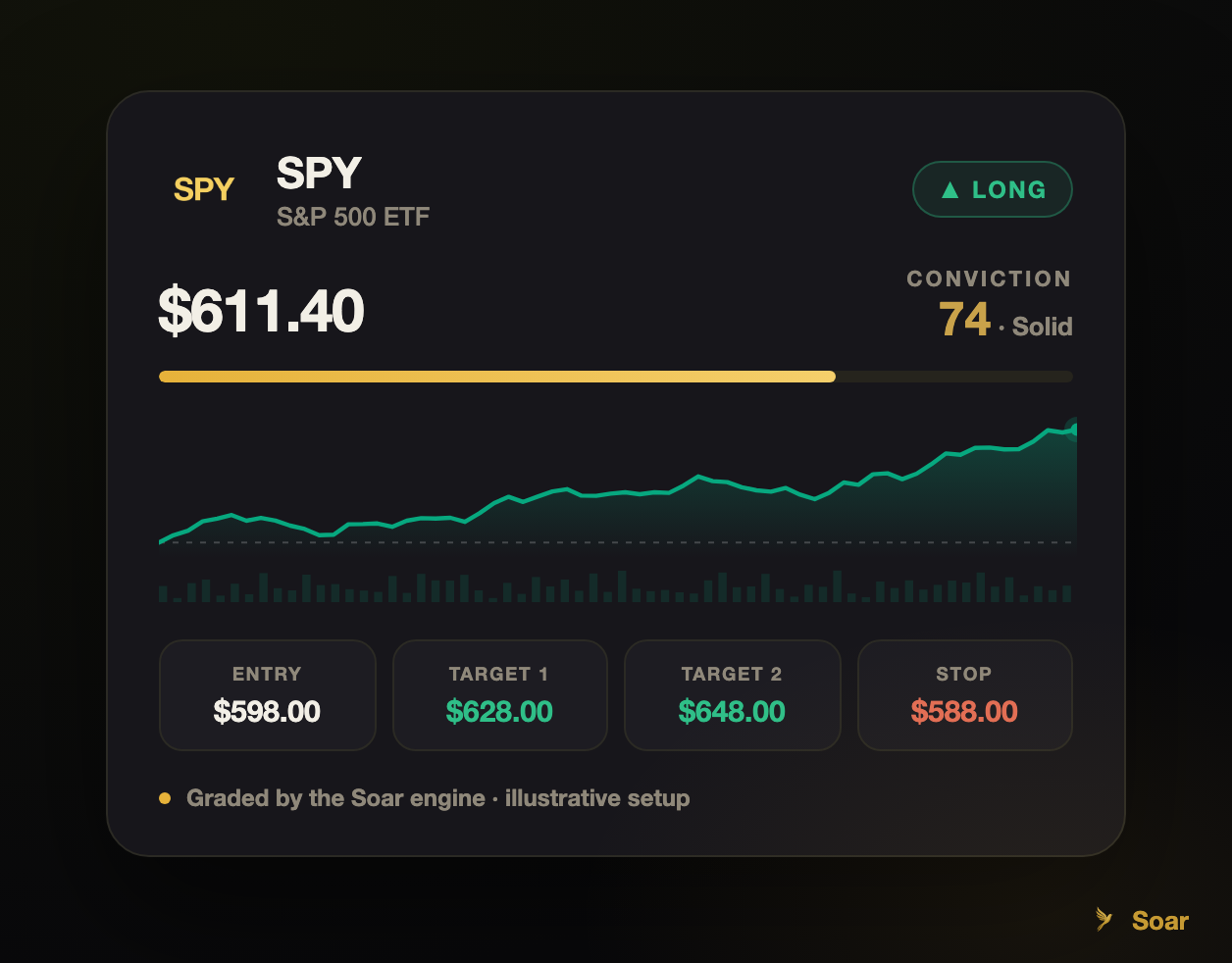
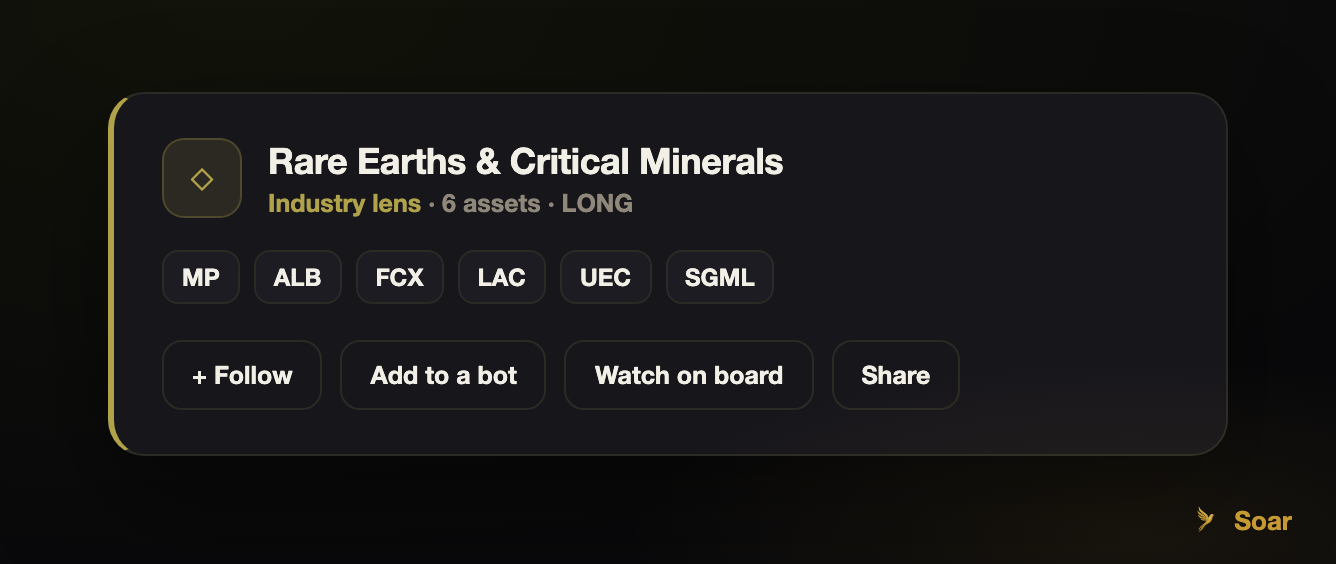
The Rare Earths & Critical Minerals strategy is one of Soar's industry baskets. It tracks companies across the mining and processing side of the theme and reads them through the Soar engine, which grades setups and frames each name in plain English. It is a lens — a curated way to follow the supply-chain narrative, keep the relevant companies in view, and see how the engine reads them as conditions shift.
A few things it is not: it is not a recommendation to buy or sell anything, it is not a claim about what the theme will do next, and it is not affiliated with any of the companies, governments, or agencies involved in the critical-minerals conversation. It's commentary on a widely-discussed public thesis, built so you can watch it unfold rather than piece it together from scattered news.
You can explore the full strategy page to see the current read, or browse the other industry baskets from the app. If you want the broader daily context these themes sit inside, the daily brief covers the macro backdrop that critical minerals are so sensitive to.
Where automation fits — and where it stops
Some Soar users pair a strategy lens like this with an automated bot that acts on the engine's signals. When they do, the design keeps one boundary firm: control of funds always stays with the user. If you self-host, your broker API keys live only on your own infrastructure and never touch Soar's servers. If you use Soar-managed hosting, your keys are stored encrypted and scoped to trade-only with your explicit consent. Either way, access is trade-only — Soar can never withdraw or move your funds. The engine can place trades you've authorized; it can't reach your money.
For a strategy as event-driven as critical minerals, that separation is worth understanding before you automate anything. The theme can move on a policy headline, and it's the user — not the tool — who decides how much conviction to give a supply-chain thesis. The help center walks through how strategies, signals, and bots connect, and more strategy write-ups live on the blog.
The short version: magnets, batteries, and chips all lean on a small, strategic set of minerals with a narrow supply gate. That concentration is what gives the theme its edge and its sensitivity. Soar's Rare Earths & Critical Minerals strategy is a way to keep that whole chain in view — the miners, the processors, and the geopolitics that keep them all in the headlines.
Informational and educational content only. Not investment advice. Trading involves risk, including loss of capital.