
What a conviction score actually means on Soar
Every Soar setup carries a conviction score. Here's what it represents, how a setup earns one, and why low-conviction ideas get cut before you ever see them.

Open any setup on Soar and you'll see a number attached to it: a conviction score. It's the first thing most people notice, and the most misread. A high score doesn't mean a setup will work. It means the setup cleared a bar — that the technical picture, the risk framing, and the timeframe all lined up well enough to survive a hard look before anyone saw it. This piece explains what that number actually represents, how a setup earns it, and — just as important — what it never claims to do.
Conviction is a quality read, not a probability
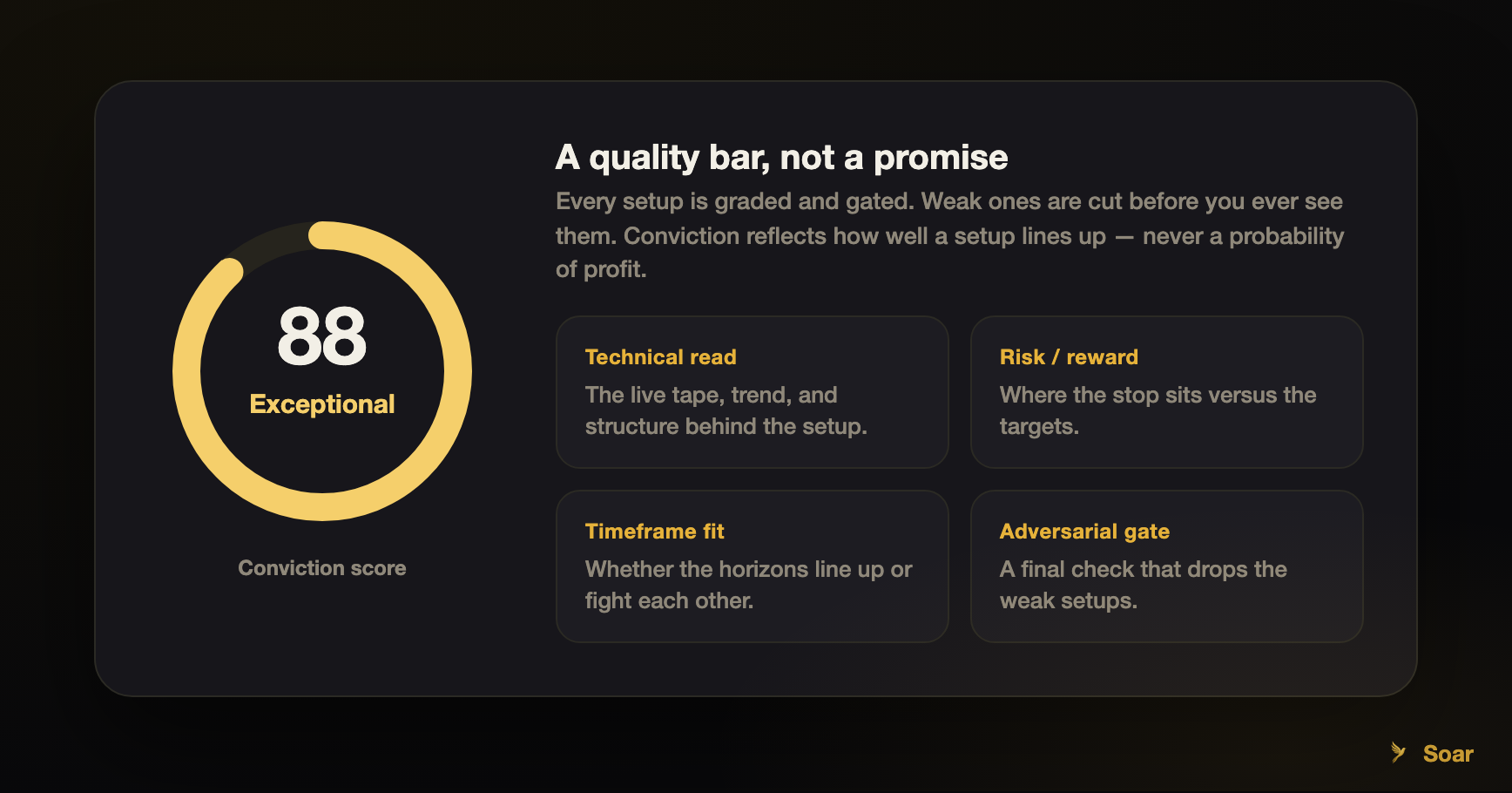
Start with the thing conviction is not. It is not a probability of profit. It is not a forecast. It doesn't say a trade will hit its target, and it never promises an outcome. Markets don't hand out guarantees, and neither does Soar.
What conviction is: a graded, risk-checked read of how clean and consistent a setup looks at the moment it's produced. Think of it the way a seasoned analyst thinks about an idea before pitching it — not "will this make money," but "is this a well-formed idea, or is it noise dressed up as a signal?" Conviction is Soar's answer to that second question, expressed as a single, scannable number so you can triage a board of setups at a glance.
A high conviction score is a statement about the quality of the setup — not a prediction about the outcome.
What actually goes into the score
A setup earns its conviction from a few reinforcing ingredients. None of them alone carries the score — they have to agree. The Soar engine weighs, in plain terms:
The technical picture — the structure of price and momentum behind the idea. A setup where the signals point the same direction reads stronger than one where they contradict each other.
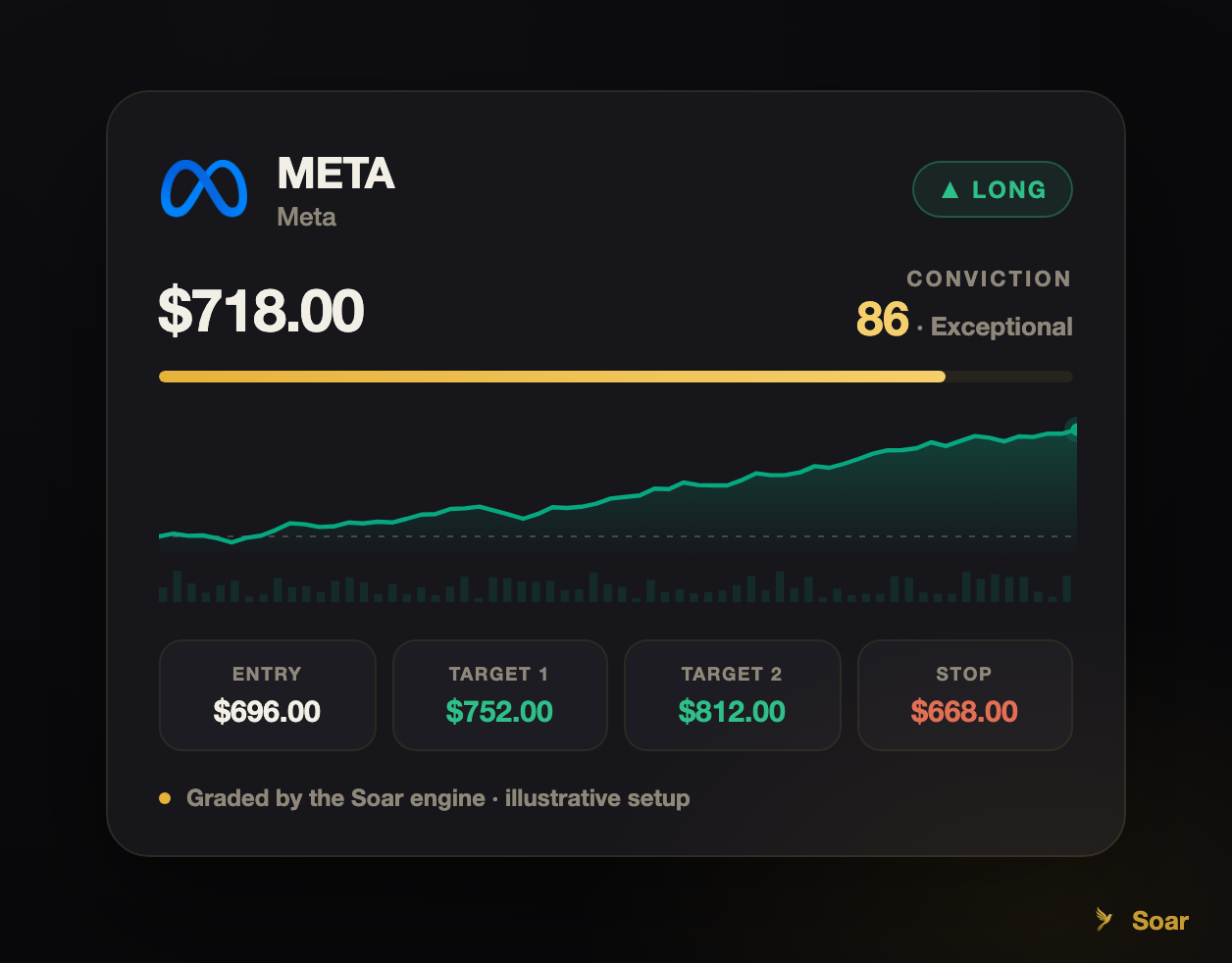
Risk and reward framing — where the entry, the stop, and the targets sit relative to each other. A setup that risks a lot to gain a little is a weaker idea than one where the reward justifies the risk, regardless of how exciting the name is.
Timeframe alignment — whether the shorter and longer views tell a coherent story. When the horizons agree, the read is more durable; when they fight, that's a caution flag baked into the score.
The number you see is the engine's summary of how well those pieces fit together — a consistency signal, not a crystal ball. You can see how this framing plays out across live ideas on the daily brief or by browsing any strategy page.
Why you never see the weak ones
Here's the part that matters most, and the part most platforms skip. Before a setup ever reaches your screen, it runs through an adversarial, multi-phase quality gate — a review whose whole job is to try to knock the idea down.
The point of an adversarial pass is that it isn't looking for reasons to publish. It's looking for reasons not to. A setup with a contradictory technical read, a lopsided risk profile, or horizons that disagree gets challenged, and if it can't hold up, it's cut. It never becomes a card. So the board you see isn't the full universe of ideas the engine considered — it's the subset that survived scrutiny. That's deliberate: a shorter list of setups that cleared the bar is more useful than a long list padded with weak ones.
This is also why conviction and "volume of ideas" pull in opposite directions on purpose. Soar would rather show you fewer, cleaner reads than flood the screen. Cutting the weak ones early is the whole design.
How to actually use conviction
Once you know what the number represents, using it gets simpler. A few practical habits:
Treat conviction as a triage tool, not a buy button. It tells you where to spend your attention first — not what to do with your capital.
Read the setup, not just the score. The entry, stop, targets, and thesis are where the real information lives. Conviction points you at the idea; the idea itself is what you evaluate.
Remember the score is a snapshot. It reflects the setup at the moment it was graded. Markets move, and a read that was clean this morning can look different by the afternoon.
Bring your own judgment. Conviction is one input into your decision, not a replacement for it. Position size, your own risk tolerance, and your read of the broader tape are still yours to weigh.
And keep the track-record context in mind: the performance Soar shows is realized — what actually happened, not a backtest or a projection. A strong conviction history is a signal about the quality and consistency of the engine's process. It is not a promise that the next setup will behave the same way.
The short version
Conviction is Soar's grade for how well a setup holds together — technicals, risk framing, and timeframe, run through an adversarial gate that drops the weak ones before you ever see them. It's a quality bar, not a payout forecast. Used that way, it does exactly what it's meant to: cut through the noise so the ideas in front of you are the ones worth a closer look. If you want to go deeper on how the engine thinks, the help center and the Soar blog unpack more of it.
Informational and educational content only. Not investment advice. Trading involves risk, including loss of capital.